Packaging guide
Fish and Chip Shop Packaging: Boxes, Paper, Cones and What to Order for a Friday
Boxes, paper and cones for chip shops, with portion weights, venting advice and a plan for the Friday order.
Why is Friday the day that tests your packaging?
A chip shop can do a third of its weekly trade between five and nine on a Friday. Every box has to fold in a second, every sheet of paper has to tear cleanly and nothing can run out at seven o'clock.
Packaging that works on a quiet Tuesday can fail on a Friday. A box with a fiddly tuck slows the counter. Paper that is slightly too small means two sheets per portion and double the cost.
This guide walks through the three main formats, the portion sizes behind them and how to plan the order so the Friday rush never finds an empty shelf.
Box, paper or cone: which does what?
Most chippies use all three. A box carries a full meal for delivery or a walk home. Paper wraps a portion that will be eaten within ten minutes. A cone serves chips to people eating as they go.
The table shows how UK shops tend to match the format to the order. Sizes are common starting points, and every item is made to your portion rather than picked from a shelf. The whole set sits in our fish and chip packaging range.
| Order | Typical portion | Common packaging | Typical size |
|---|---|---|---|
| Fish and regular chips | One fillet plus 300 g chips | Lidded box, paper under the fish | 250 × 160 × 50 mm |
| Large fish and chips | One large fillet plus 450 g chips | Large lidded box | 300 × 180 × 60 mm |
| Regular chips only | 300 to 350 g | Chip scoop box or paper wrap | 150 × 110 × 60 mm |
| Large chips only | 450 to 500 g | Large scoop box or double wrap | 180 × 130 × 70 mm |
| Chips to walk with | 150 to 200 g | Paper cone | 230 mm tall cone |
| Kids chips | 100 to 120 g | Small cup or bag | 90 mm cup |
| Sausage, pie or fishcake | One item | Paper wrap or small bag | 200 × 300 mm sheet |
How big are regular and large chip portions?
Portion weights vary more between chip shops than any other takeaway food. A regular in one town is a large in the next. So weigh your own scoop before you size anything.
Put your regular scoop on the scales ten times on a busy night and take the average. Many shops land between 300 and 350 g for a regular and 450 to 500 g for a large. A heaped scoop can be 100 g more than a level one.
That number drives the box. Chips sit at roughly 0.5 g per cubic centimetre when loosely piled, so 300 g needs about 600 cubic centimetres of space. The open chip scoop boxes are sized from exactly that figure.
Large and regular also need to look different in the hand. If the large box is only 20 mm longer, customers who paid for a large feel short-changed. A step of 50 mm in length or 10 mm in depth is enough to see across the counter.
What size box fits a fish and regular chips?
A battered cod or haddock fillet is usually 200 to 250 mm long once cooked. The box has to take the fillet flat without bending the batter, with the chips underneath or alongside.
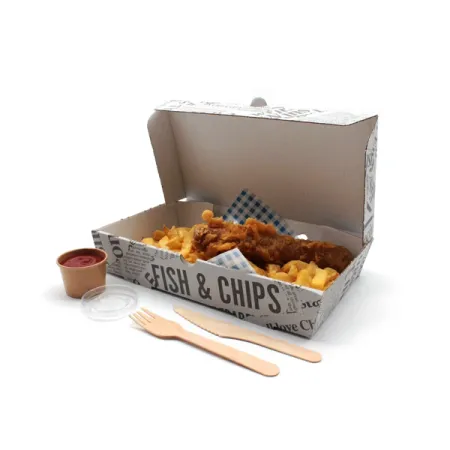
A common inside size is 250 × 160 × 50 mm. Chips go in first, the fish lies on top and the lid closes with the batter just touching it. For a large fillet with 450 g of chips, 300 × 180 × 60 mm is more usual.
If your fillets run long, say so. A 270 mm fillet in a 250 mm box gets folded, and folded batter cracks. The lidded fish and chip boxes are cut to your fillet length and your scoop weight.
How do you keep batter crisp in a closed box?
Batter stays crisp while the air around it stays dry. In a closed box the chips give off steam, the steam condenses on the lid and drips onto the fish. Within ten minutes the batter goes soft.
Vent cut-outs in the lid let the steam out. Two or three slots of 10 by 30 mm near the lid edge make a clear difference, and the box still holds the heat for a short journey.
Also drain the fish for thirty seconds on the rack before boxing. Lay a sheet of greaseproof under it so the batter is not sitting in chip fat. Which paper copes with hot fat is covered in our greaseproof paper and coated board guide.
When does paper beat a box?
For eat-in or eat-soon orders, paper wins. It is quicker to wrap than to fold a box, it costs less per portion and it lets steam escape through the folds.
The classic chip shop wrap uses a sheet of about 400 × 300 mm for a regular portion and 450 × 350 mm for a large. Printed greaseproof carries your name on the outside of every wrap, which is free advertising on the walk home.
Many shops wrap the portion in paper and then drop the wrap into a box for delivery. The paper takes the grease, the box takes the knocks. See the printed fish and chip paper for sheet sizes.
Where do cones and bags fit in?
A cone is the fastest way to serve chips to someone who is walking. It is open at the top so steam escapes, and it can be held in one hand with the other free for a fork.
A cone holding 150 to 200 g is about 230 mm tall. Seaside shops and shops near pubs and stadiums sell a lot of chips this way at a lower price point than a boxed portion. The paper chip cones are printed flat and rolled at the counter.
Flat paper chip bags do a similar job for shops that want the chips to stay warmer. The bag folds over at the top, so it is better for a short walk than a cone but worse for crispness.
Which wrap and box combinations work?
There is no single right set-up. The combinations below are the ones we see most on reorders from UK chip shops, with a note on why each one works.
Sides complicate the picture. Curry sauce, gravy and mushy peas go in a lidded pot, never loose in the box. The pot sits in the bag beside the box rather than on top of the chips. Pickled eggs and gherkins get a small bag of their own. If the pot has to go in the box, choose the next size up and keep the pot in a corner, away from the fish.
- Paper wrap only: eat-in, café tables and short walks home
- Paper wrap inside a lidded box: delivery apps and long journeys
- Scoop box with a sheet of greaseproof: chips only, counter collection
- Cone for chips, box for fish: seaside and event trade
- Small cup for kids portions, bag for sausages and fishcakes
How many of each should you order for a Friday?
Work from one Friday's sales, not a weekly total. Friday sets the peak, and the rest of the week fits inside it. Count the portions by format for two Fridays and use the higher figure.
Then decide how many weeks one order should cover. Paper and cones take little space, so eight to twelve weeks is sensible. Flat boxes take more room, so six to eight weeks is more common. Keep the chip bags next to the fryer in a holder, and store spare printed paper chip bags flat in their carton until needed.
- Count Friday portions by format: boxed meals, paper wraps, cones, bags.
- Multiply each by the number of Fridays one order should cover.
- Add the quieter days as a percentage of Friday, often 60 to 70 percent across the week.
- Add 10 percent for wastage, misfolds and the occasional second sheet.
- Check the storage space, then trim the order to what fits off the floor.
How do you order chip shop packaging?
Send us your portion weights, your fillet length and a rough Friday count, with your logo. Each item comes back as a free design proof before print.
Every quote is written and starts from £0.25 per unit, with the quantity agreed on that order. Food-contact materials available on request. Sign off the proof and the print run takes 4 to 6 business days, then free tracked delivery to any UK postcode adds 2 to 3 business days.
Order at least two weeks before the shelf runs dry, and sooner before a bank holiday weekend. If you need a carrier for the whole order, the paper takeaway carrier bags can be printed to match the boxes.