Packaging guide
Burger Box Sizes: Which Box Fits a Single, Double and Loaded Burger?
Inside sizes in millimetres for single, double and loaded burgers, the 5 mm rule and how boxes stack in a bag.
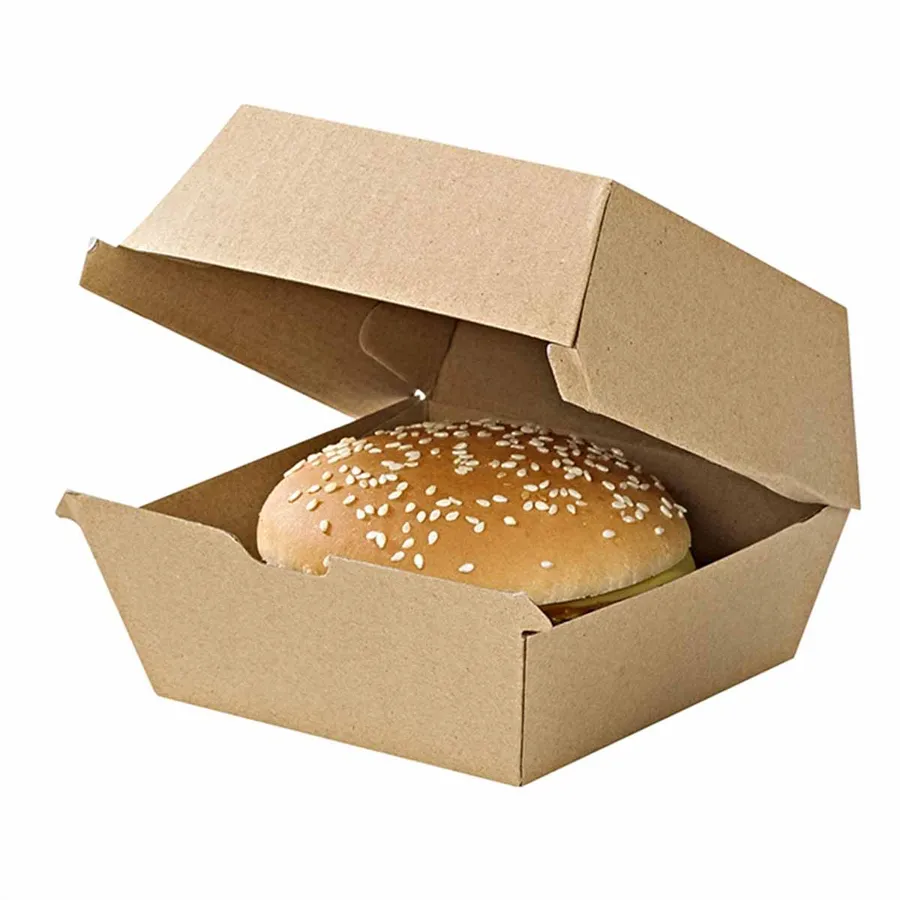
Why does the bun decide the box size?
A burger box is sized from the bun, not the patty. The bun sets the footprint and the build sets the height. Get those two numbers right and the box almost chooses itself.
Most UK burger menus use a 4 inch bun. That is about 100 mm across once baked, and a little more if it is a soft brioche that spreads in the oven.
The box then needs a small gap on each side so the bun is not squashed. Too much gap and the burger slides about and smears sauce on the lid. The standard printed burger boxes we make are cut to whatever gap you want.
Bakers still sell buns by the inch and box makers work in millimetres. A 3 inch bun is about 75 mm and suits sliders. A 4 inch bun is about 100 mm, a 4.5 inch bun about 115 mm and a 5 inch bun about 125 mm.
Measure your own buns rather than trusting the label. Proving and baking vary by batch, and a bun sold as 4 inch can come out at 105 mm. Measure five, take the widest and size from that.
A box that fits well also looks fuller in a photo. Customers judge a takeaway burger by the first sight of the open lid. Twenty millimetres of empty space on every side makes a good burger look small.
Which inside sizes fit single, double and loaded burgers?
The table gives starting points we see on quotes for UK takeaways. The inside size is what matters. Board thickness adds a few millimetres to the outside, so always quote inside measurements.
A single on a 4 inch bun with cheese and a slice of tomato stands about 75 mm tall. A double with two patties and cheese is close to 105 mm. A loaded burger with onion rings or hash browns can pass 120 mm.
Heights in the table assume a flat lid. If your top bun is domed and tall, add 5 mm more. If you squash the bun with the lid, the cheese sticks to the board and the first impression is lost.
| Burger | Bun | Typical build height | Inside box size to ask for |
|---|---|---|---|
| Slider | 3 inch (75 mm) | 50 to 55 mm | 80 × 80 × 60 mm |
| Single on a plain bun | 4 inch (100 mm) | 70 to 80 mm | 105 × 105 × 85 mm |
| Single brioche with salad | 4 inch (100 mm) | 85 to 95 mm | 110 × 110 × 100 mm |
| Double with cheese | 4 inch (100 mm) | 100 to 110 mm | 110 × 110 × 115 mm |
| Loaded or stacked | 4 to 4.5 inch | 115 to 130 mm | 120 × 120 × 135 mm |
| Smash double on a large bun | 4.5 inch (115 mm) | 90 to 100 mm | 125 × 125 × 105 mm |
Does the box style change the size you ask for?
Yes, a little. A clamshell closes with a hinged lid, so the lid itself needs 5 mm of headroom to swing shut over the top bun. A tuck-top box closes flat and can sit closer to the build.
Board thickness also differs. Folding board is under 1 mm, so inside and outside sizes are nearly the same. E flute corrugated adds about 1.5 mm per wall, which matters when four boxes line up in a bag.
If you want the sturdier hinged style, the hinged clamshell burger boxes are quoted on the same inside sizes as the table above. Just add the headroom for the lid.
How do sauce, lettuce and toppings change the height?
Height is where most burger boxes go wrong. Shops measure the bun, forget the build and end up with a lid that crushes the top.
Shredded lettuce adds about 10 mm. A slice of tomato adds 8 mm. Two rashers of bacon add 5 mm, and an onion ring adds 15 mm or more. Stack those on a double and you pass 130 mm before the top bun goes on.
Sauce changes the footprint rather than the height. A loose sauce spreads to the box wall and soaks it. Pair a saucy build with a printed greaseproof burger wrap inside the box, or ask for a grease-resistant lining on request.
What is the 5 mm rule?
Add 5 mm to each side of the widest bun measurement, and 10 mm above the tallest build. That is the inside size to ask for.
So a 100 mm bun needs a 110 mm inside footprint. A 95 mm build needs an inside height of 105 mm. Round up to the nearest 5 mm if you like neat numbers.
The gap matters more than it looks. With under 5 mm, the lid drags the bun as it closes and smears the sauce. With more than 15 mm, the burger slides on the journey and arrives leaning against the wall.
For slider menus the rule still holds, just with smaller numbers. A 75 mm bun wants an 85 mm footprint, which is why small burger boxes for sliders are a separate size rather than a scaled-down single.
Do you need a separate box for a double?
Some shops run one tall box for everything. It saves a stock line, but a single looks lost in a 115 mm tall box and the lid has nothing to press against.
If doubles are more than a fifth of your orders, a second box pays for itself in how the food arrives. The taller double burger boxes are cut with the same footprint and about 30 mm more height.
Keep the two boxes the same footprint. Your staff can then grab either without thinking, and both sit the same way in a bag.
When does a burger and chip box make more sense?
A meal deal is a burger and a portion of chips. Two separate boxes cost more and take up more bag space. One divided box keeps the burger upright and the chips in their own half.
Chips in a shared box need venting. Trapped steam softens the bun from the side. Ask for vent cut-outs on the chip side and a solid wall between the two halves.
A common combined size holds a 4 inch burger on one side and 150 to 200 g of chips on the other. See the divided burger and chip boxes for what that looks like.
How do burger boxes stack in a delivery bag?
A burger box has to fit the bag, not just the burger. Measure the base of your takeaway bag before you fix a footprint.
Two 110 mm boxes sit side by side in a bag with a 250 mm base, with room for a chip cone between them. Three in a row need 340 mm, which is a large bag.
Boxes also need to stack. A flat lid with a locking tab holds the box above it. A domed lid does not. Tell us the bag you use and we size the box to fill it without rattling. Our printed paper takeaway bags can be made to match the boxes.
What are the common mistakes with burger box sizes?
We see the same five mistakes on reorders, usually from boxes bought on a size name alone.
Each one is cheap to avoid before the first run and expensive to live with for a thousand units.
The cheapest fix is a ruler and ten minutes at the pass. Measure what you actually serve on a Friday night, not the burger on the menu photo.
- Ordering by a menu name, such as medium, instead of millimetres
- Measuring the patty, which is narrower than the bun it sits on
- Forgetting the lid thickness when checking the bag fit
- One box for singles and doubles, so one of them always looks wrong
- No vent on a box that also carries chips
How do you order burger boxes to your size?
Email or WhatsApp us the numbers with your logo, or ring +44 7578 382054 and read them out. Everything is priced from £0.25 per unit and confirmed in writing, with the quantity agreed when you order. Food-contact materials available on request.
For the rest of the menu, our UK food packaging sizes guide covers chips, wraps and bags.
- Measure five buns across and note the widest.
- Build your tallest regular burger and measure it with a ruler.
- Add 5 mm per side and 10 mm to the height.
- Tell us the bag base size so the boxes stack and fit.
- Approve the free design proof, then allow 4 to 6 business days for production.
- Your boxes then travel free and tracked to any UK address, which takes 2 to 3 business days.